Learn the 10,000 words that matter — and never forget them
Build your Norwegian or Vietnamese vocabulary with common words taught in real sentence context. Smart spaced repetition schedules reviews at the optimal moment, so words stick long-term.
Free to use · Sign in with Google or email · Runs in your browser
Not ready? Try the account-free demo below ↓
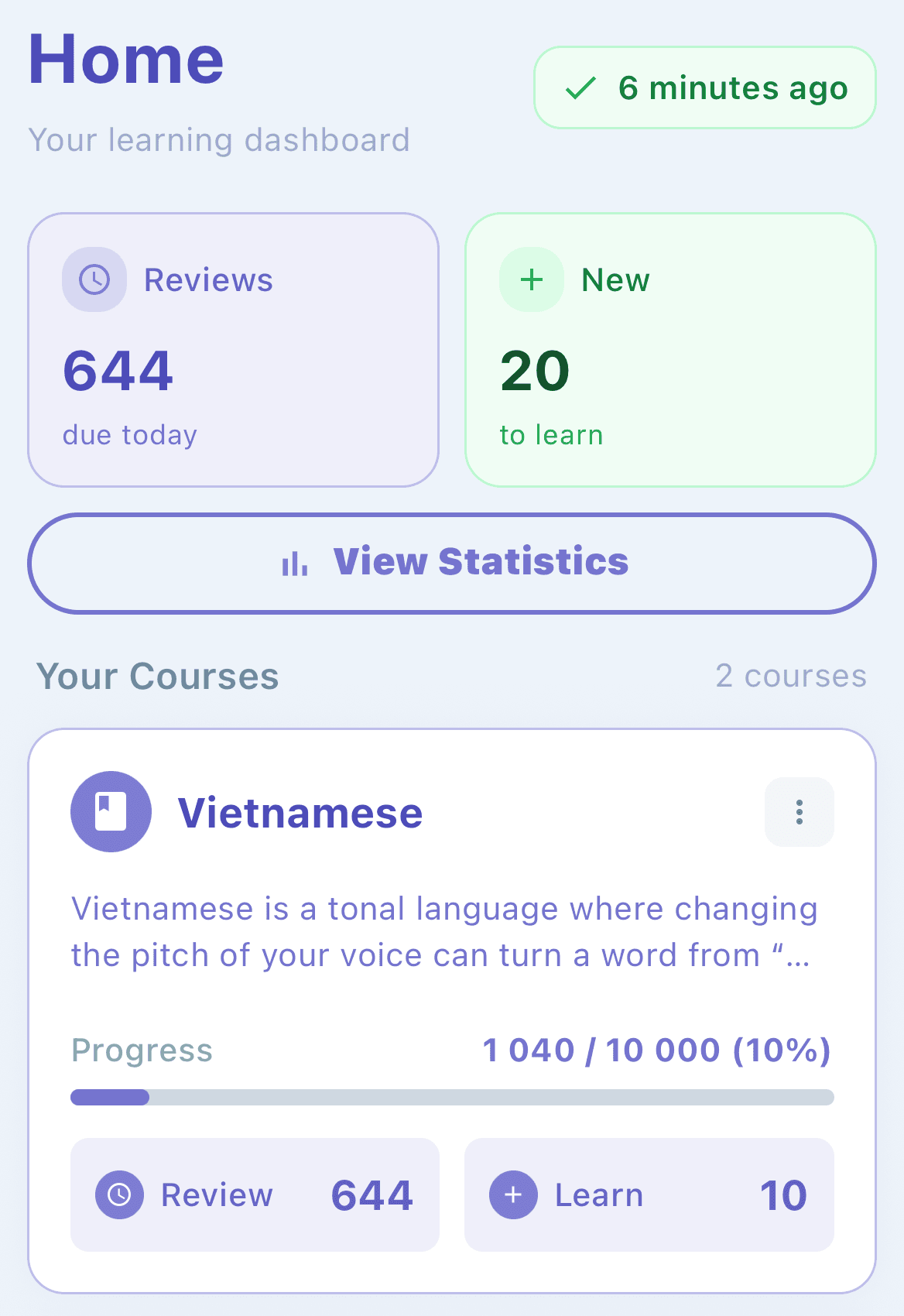
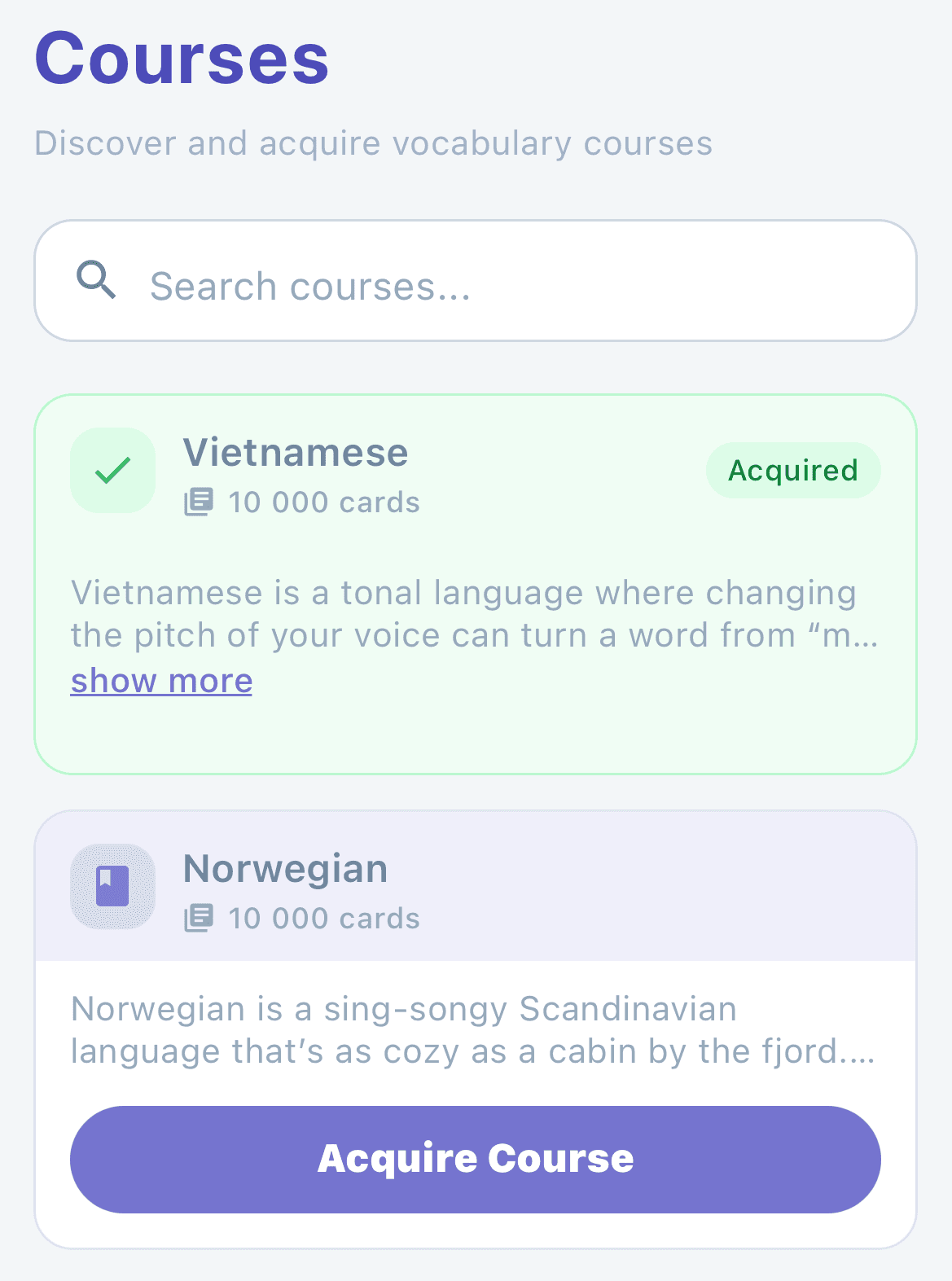
Supported Languages
Start learning today, with more languages on the way.
How It Works
MassVocabulary combines frequency-ordered vocabulary with contextual learning and spaced repetition for maximum retention.
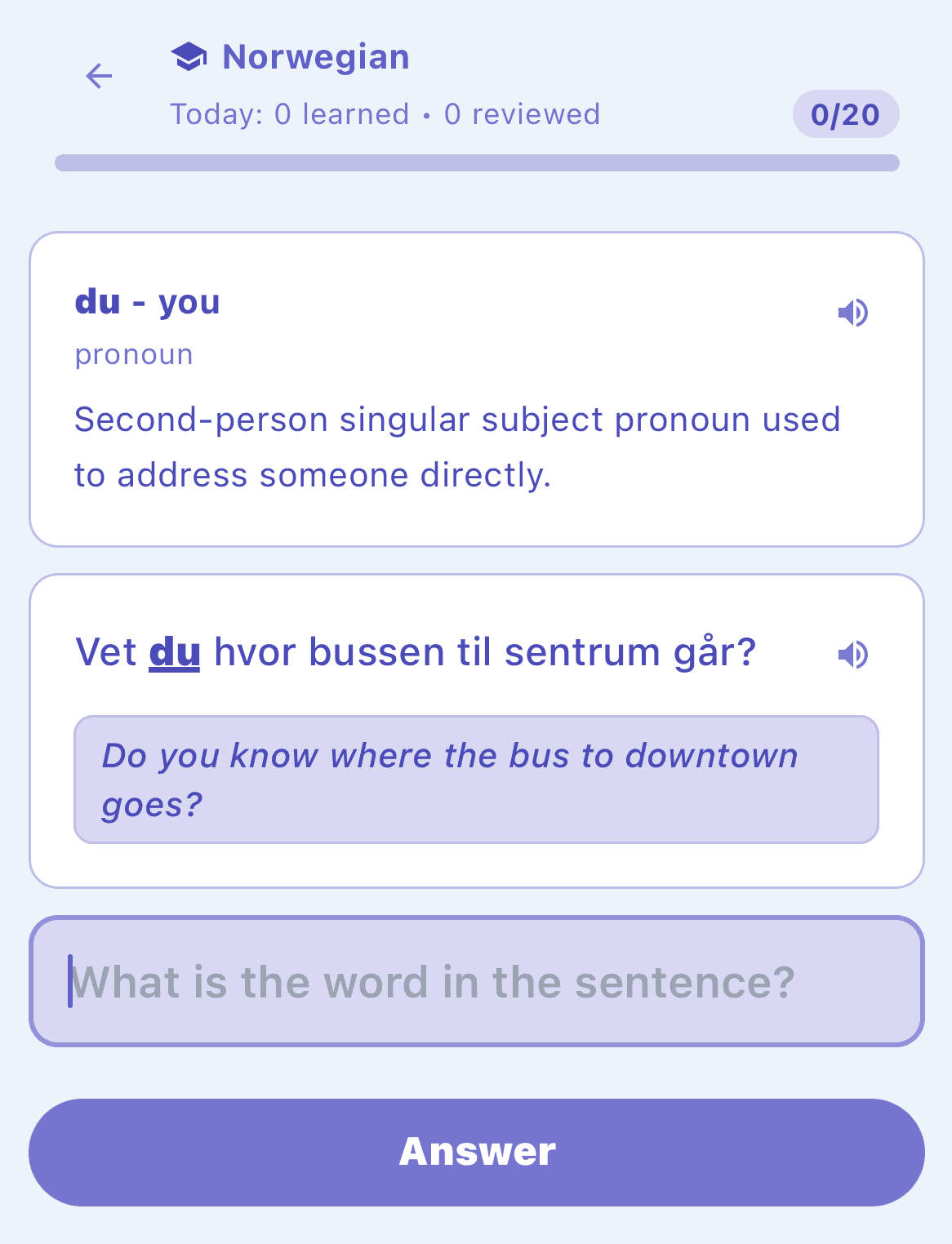
Learn Words in Context
Each word is presented within a real example sentence, showing you how it's actually used in natural speech.
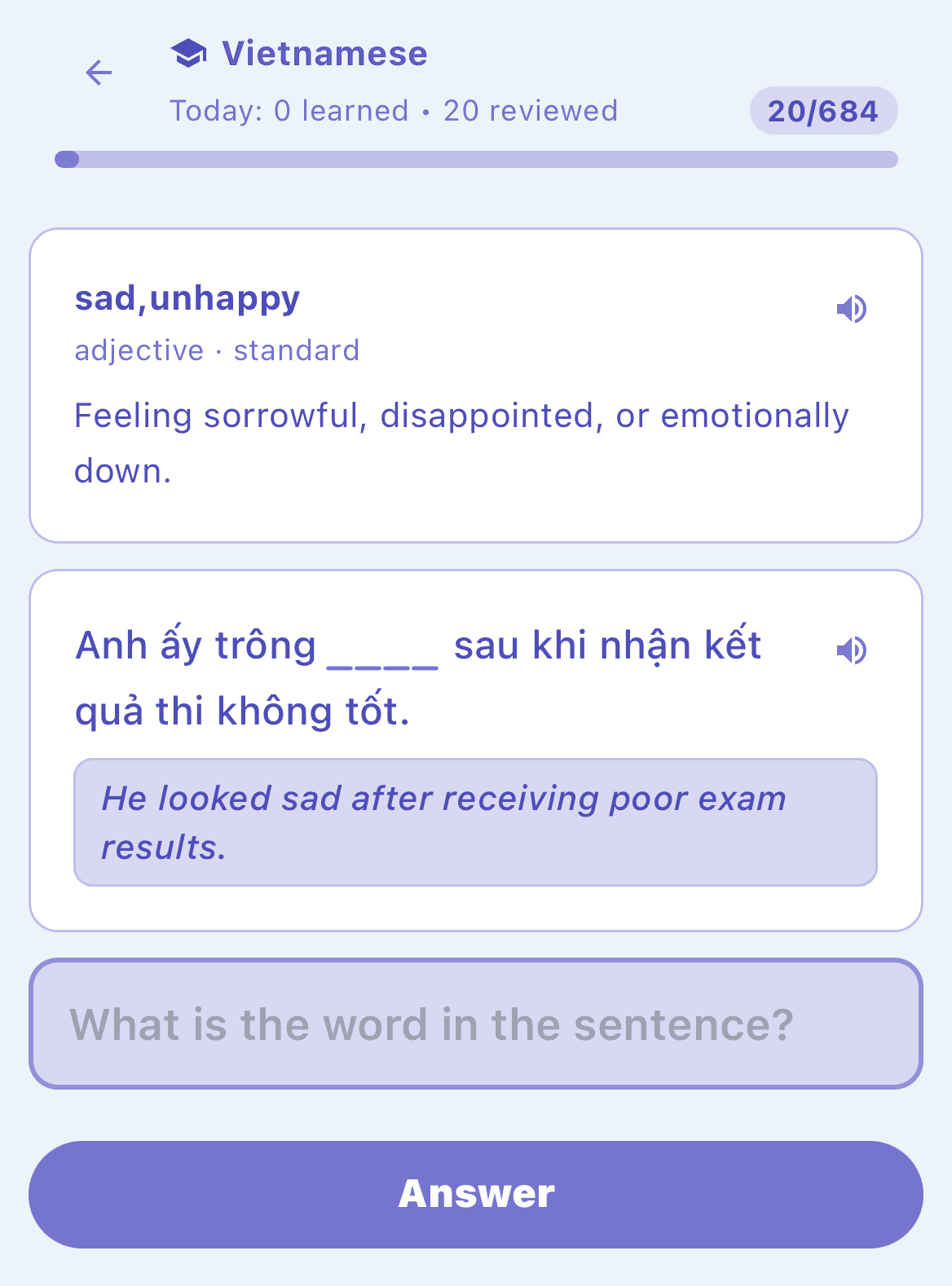
Recall from Context
During review, the target word is hidden. You recall it from the sentence context, training natural usage.
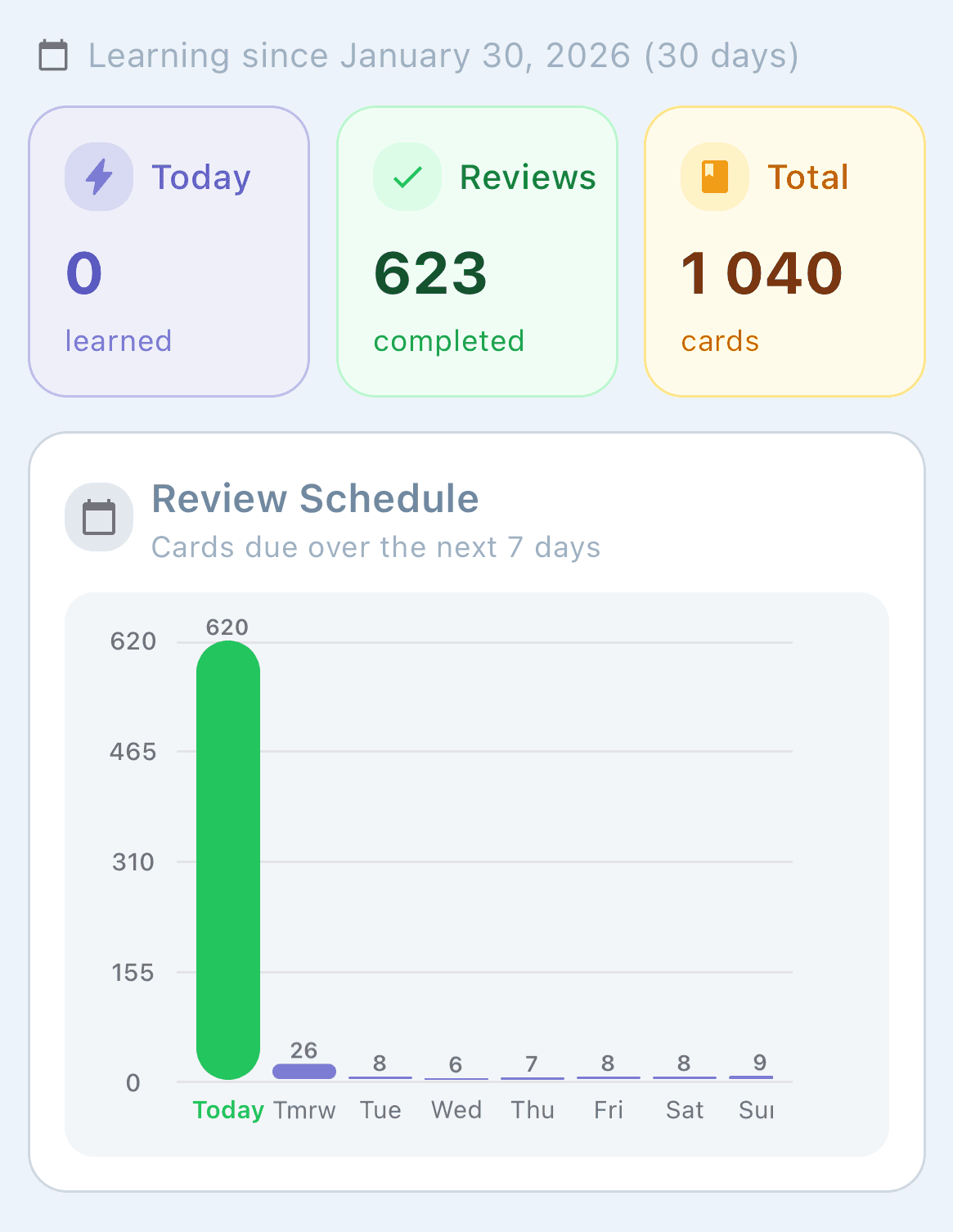
Smart Scheduling
FSRS calculates the optimal review time for each word. Difficult words appear more often, easy ones less frequently.
Everything You Need to Master Vocabulary
No cartoon mascots, no minigames, no grammar drills you didn't ask for — just the words that matter, built on proven learning science.
10,000 Frequency-Ordered Words
Learn the most important words first. Every course contains 10,000 words sorted by how often they appear in real usage, so you can start having real conversations faster.
Contextual Learning with Word Hiding
Every word comes with an example sentence. During review, the target word is hidden and you recall it from context—training your brain to use words naturally.
FSRS Spaced Repetition
Built on FSRS, the state-of-the-art scheduler trusted by millions of Anki users and backed by peer-reviewed research. MassVocabulary calculates the perfect time to review each word based on your performance, ensuring long-term retention.
Audio Learning
Every word comes with native pronunciation. Hear the word, hear it used in context. Audio playback helps cement pronunciation and improves listening comprehension.
Detailed Analytics
See exactly how you're progressing. Track retention rates, learning stability, and more. The 30-day forecast shows what's coming up so you can plan your study sessions.
Streaks, XP & Mastery
Stay motivated with daily streaks, experience points and levels, and a growing count of mastered words. Progress you can see turns a habit into momentum — without cartoon mascots or minigames.
Built for beginners and intermediates alike
New to a language?
Start fresh with curated courses. Learn the most common words first with frequency-ordered vocabulary — the fastest path to real conversations.
Stuck at the intermediate plateau?
Focus on the vocabulary that's actually holding you back. Spaced repetition surfaces the words you keep forgetting and keeps them in front of you until they stick.
Web
Available
iOS
Coming soon
Android
Coming soon
Why Focus on Vocabulary?
Grammar, stories, and games all have their place — but words are what unlock a language first. Here's why we put vocabulary at the center of everything.
80%+
of everyday speech
A small core carries most communication
In any language, a few thousand of the most frequent words account for the overwhelming majority of what people actually say and write. Master that core first and you understand most of what you hear — long before you finish a grammar textbook.
Meaning first
comprehension is word-bound
Vocabulary sets the ceiling on understanding
You can know every grammar rule and still be lost if you don't know the words. Research on reading and listening comprehension consistently finds vocabulary size to be the strongest single predictor of how much you understand.
Acquired
not memorized
Grammar is absorbed through input
Grammar patterns are best acquired by seeing words used in real sentences, not by drilling rules in isolation. Every word here is taught in context, so you internalize structure naturally as your vocabulary grows.
That's why MassVocabulary is 100% vocabulary-focused: no games, no cartoons, no grammar drills you didn't ask for — just the words that matter, in frequency order, scheduled so you never forget them.
The Forgetting Curve
Without Spaced Repetition, You Lose What You Learn
Research by Hermann Ebbinghaus showed that memory decays exponentially. Every word you study without a review schedule is a word you'll forget.
56%
After 1 hour
forgotten without review
66%
After 1 day
forgotten without review
75%
After 6 days
forgotten without review
With FSRS spaced repetition, our community retains vocabulary long-term — MassVocabulary schedules reviews at the exact moment before you forget, turning short-term memorization into lasting knowledge.
Why Do You Need 10,000 Words?
Ten thousand sounds like a lot until you look at what each thousand actually buys you. The research on lexical coverage is unusually clear about where the finish line is.
3,000
words
~95% of everyday conversation
You can follow the gist
Three thousand of the most frequent word families cover about 95% of casual speech. That still leaves roughly one unknown word in every twenty — enough to keep up, not enough to stop guessing.
4,000
words
~95% of a novel
You can read with a dictionary
Written language is denser than speech, so it takes around four thousand families to reach the same 95% mark across novels and newspapers. Reading works, but it is still work.
7,000
words
~98% of spoken English
Listening becomes unassisted
98% coverage is the threshold where comprehension stops depending on outside help. For unscripted speech — conversation, radio, film — that takes six to seven thousand word families.
9,000
words
~98% of written English
Reading becomes unassisted
The same 98% threshold for written text needs eight to nine thousand families. This is the point where you read a book for the story instead of for the vocabulary.
10,000 is the milestone designed to clear both thresholds. Reaching 10,000 words gives you the depth needed for unassisted reading and listening, leaving you ready to understand native content without constantly reaching for a dictionary.
Coverage research counts word families — a headword plus its inflections and derivations — so treat these as calibrated targets rather than exact counts. The direction is what matters: comprehension climbs steeply through the first few thousand words, then demands far more vocabulary for the last few percent.
Research & Citations
Stop forgetting. Start retaining.
You've seen the science. Learn the 10,000 words that matter, scheduled so you actually keep them — free to use.
Free to use · Sign in with Google or email · Runs in your browser
Not ready? Try the account-free demo above ↑