Understand everyday Norwegian : start with the words people use most
Norwegian is ranked among the easiest languages for English speakers by the U.S. Foreign Service Institute. MassVocabulary teaches the 10,000 most useful Bokmål words in frequency order and in context, with an FSRS spaced-repetition engine that reschedules every word for the moment before you'd forget it. New to the alphabet? Start with the script course and learn æ, ø, å and Norwegian sounds first.
Free right now: no daily limit on new words, and unlimited reviews.
Not ready? Try the account-free demo below ↓ or How many Norwegian words do you know? 2-minute test
How It Works
MassVocabulary combines frequency-ordered vocabulary with contextual learning and spaced repetition for maximum retention.
Learn the Sounds
Languages with a script course let you start with the letters and sounds before any words.
Learn Words in Context
Each word is presented within a real example sentence, showing you how it's actually used in natural speech.
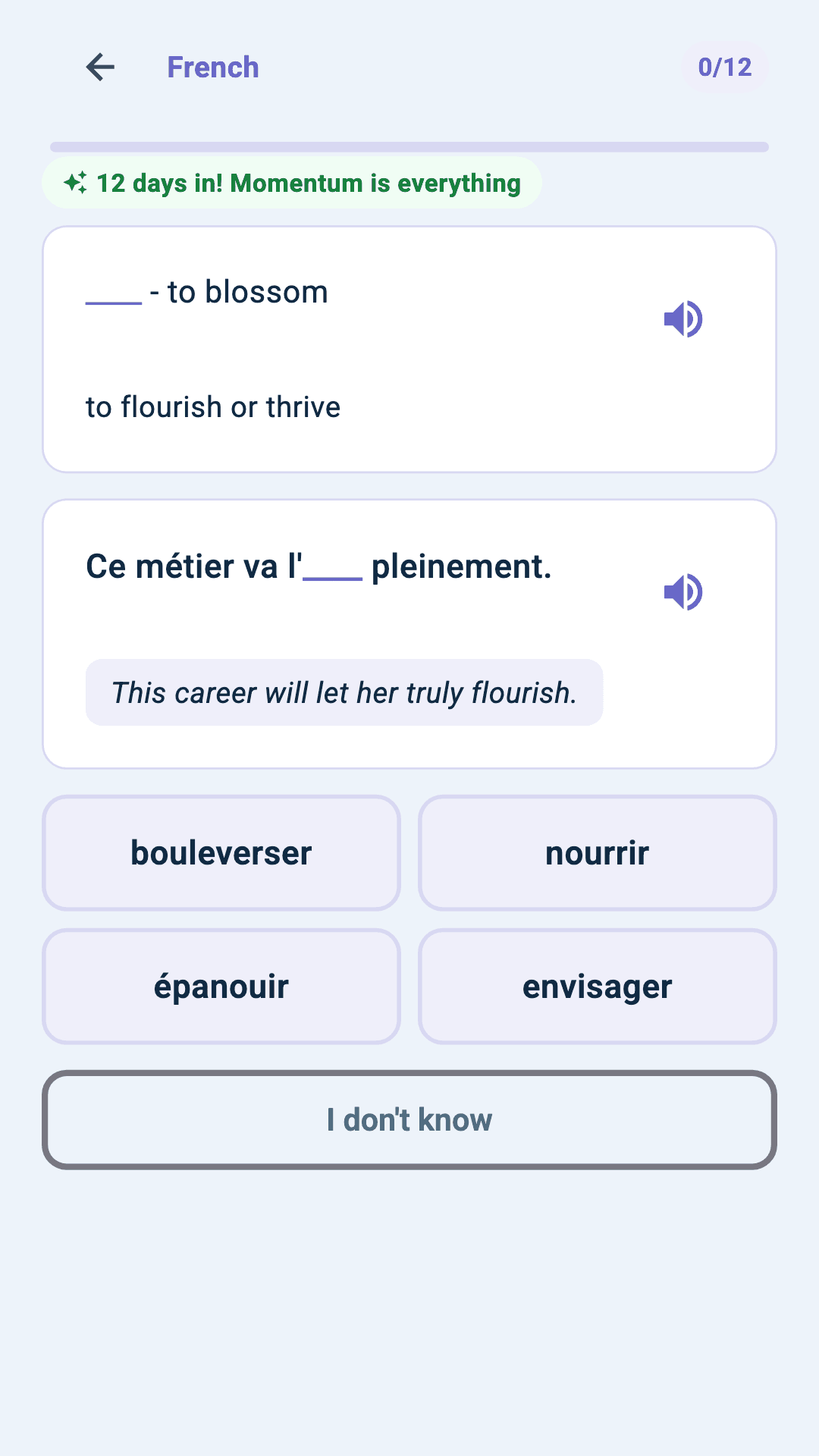
Recall from Context
During review, the target word is hidden. You recall it from the sentence context, training natural usage.
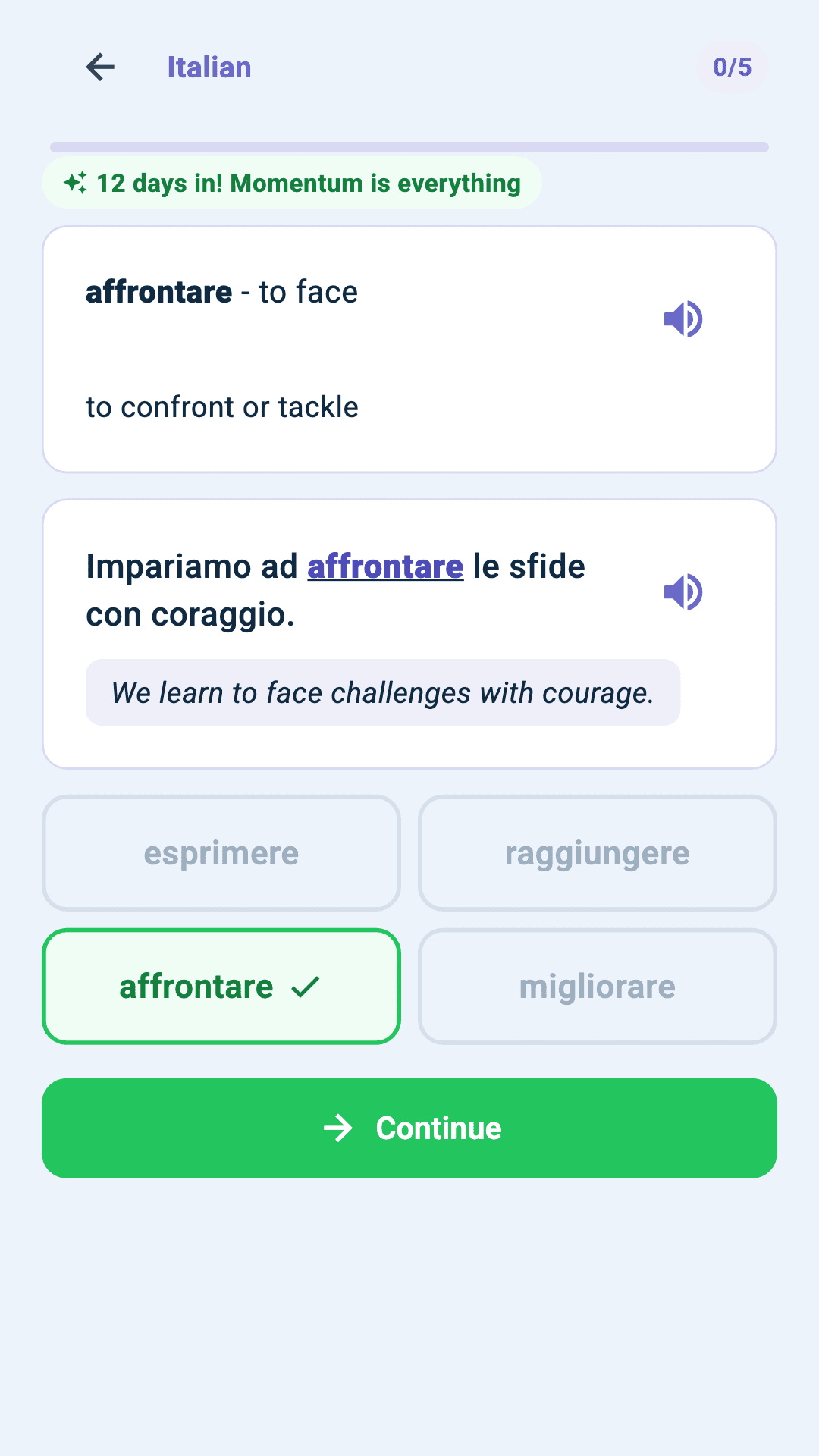
Smart Scheduling
FSRS calculates the optimal review time for each word. Difficult words appear more often, easy ones less frequently.
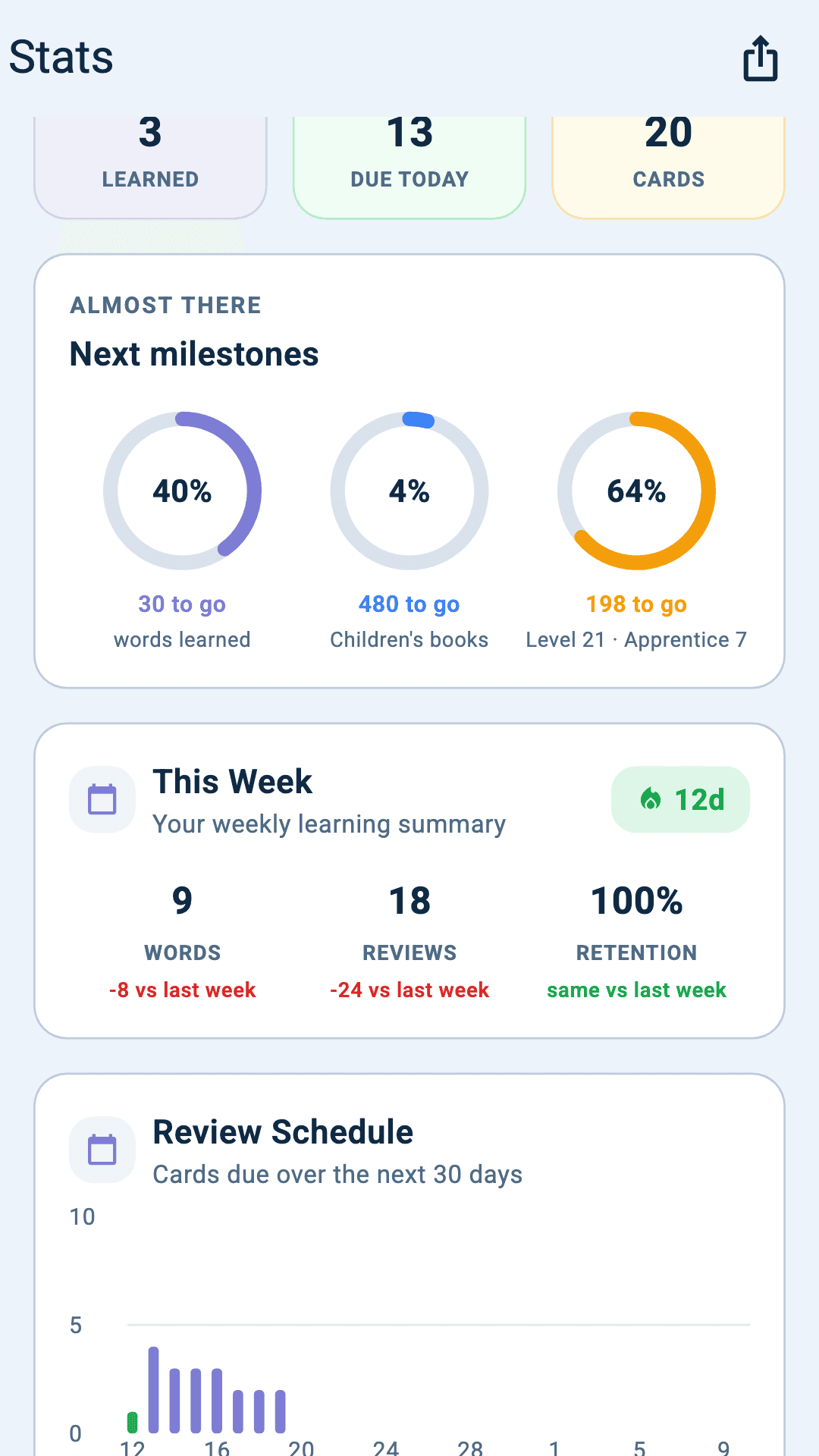
Bokmål or Nynorsk?
Norwegian has two official written standards — and one clear place for a foreign learner to start.
Bokmål
Start hereThe primary written form for the large majority of Norwegians, used across national media, business, and nearly all learning materials. If you're learning Norwegian from English, this is the standard to learn — and it's the one MassVocabulary teaches.
Nynorsk
The other standardNorway's second official written standard, built from rural dialects and used by a minority of Norwegians, concentrated in the west. Norwegian schoolchildren learn both, but foreign learners can function entirely with Bokmål.
One thing that surprises new learners: neither is a spoken standard. Norwegians speak their regional dialects — there's no single "correct" spoken Norwegian — so learning written Bokmål gives you a shared reference point for the speech you'll actually hear.
Why Norwegian Is Approachable
If you already speak English, you have a real head start on Norwegian — here's why.
Among the easiest for English speakers
The U.S. Foreign Service Institute places Norwegian in Category I — its tier of languages closest to English — estimating roughly 24 weeks of intensive study to professional working proficiency. Casual, conversational comfort comes a lot sooner.
Shared Germanic roots
English and Norwegian both descend from a common Germanic ancestor, so grammar and core vocabulary often feel familiar rather than foreign. You're building on ground you already half-know.
Words English already borrowed
During the Viking age, English absorbed a layer of Old Norse — everyday words like egg, knife, sky, window, they, and take. You'll keep meeting Norwegian words that are startlingly close to English.
Norwegian words English speakers already recognize
What You Get
Each feature answers a reason learners stall, so you keep going until the words stick.
“I don't know which words to learn”
The words you'll actually hear
Courses of 10,000 words ordered by how often people use them, so every session pays off.
“Flashcards don't stick”
Recall from real sentences
The word is hidden in a real sentence, with native audio. You recall it the way you'll need it.
“I forget everything”
Reviews right before you forget
FSRS plans each review for the moment you would otherwise forget it.
“I can't read the alphabet”
Start with the sounds
A short script course teaches letters and sounds before words.
“I don't get why it's said that way”
Notes and grammar on every card
Tap a card for word notes, sentence notes and the grammar behind it, where a course has them.
“I quit after a week”
Streaks, XP and freezes
Daily streaks, XP and levels. A streak freeze saves your streak on a missed day.
“Is this even working?”
See how much you understand
Your mastered words, plus an estimate of how much everyday text your words cover.
“I want it my way”
Study your way
Answer by self check, multiple choice, letter groups or writing. Choose reviews first, mixed or new words first.
Built on What Research Shows
Vocabulary size sets the ceiling on understanding, and review timing decides what you keep. Here is the evidence behind the method.
80%+
of everyday speech
A small core carries most communication
A few thousand of the most frequent words account for the overwhelming majority of what people actually say and write. Learn that core first and you understand most of what you hear.
98%
of words known
Where comprehension stops needing help
Research on English finds unassisted listening takes about 6,000-7,000 word families and unassisted reading 8,000-9,000. 10,000 words is the milestone designed to clear both thresholds.
75%
forgotten in 6 days
Without review, memory fades fast
Ebbinghaus found people forget 56% after 1 hour and 75% after 6 days. MassVocabulary schedules each review for just before you would forget.
Read the research behind spaced repetition
Coverage research counts word families — a headword plus its inflections and derivations — so treat these as calibrated targets rather than exact counts.
Research & Citations
- Nation, I. S. P. (2006) — How Large a Vocabulary Is Needed for Reading and Listening?
- Hsueh-chao, M. H. & Nation, P. (2000) — Unknown Vocabulary Density and Reading Comprehension
- Kremmel, B. et al. (2023) — Unknown Vocabulary Density and Reading Comprehension: Replicating Hu and Nation (2000)
- Schmitt, N. (2008) — Instructed Second Language Vocabulary Learning
- Ebbinghaus, H. (1885) — Memory: A Contribution to Experimental Psychology
- Ye, J. (2024) — FSRS: A Modern Spaced Repetition Algorithm
- Pimsleur, P. (1967) — A Memory Schedule
How many Norwegian words do you know?
How many Norwegian words do you know? A free two-minute estimate, no account needed.
Languages and platforms
Start learning today, with more languages on the way.
New to a language?
Start fresh with curated courses. Learn the most common words first with frequency-ordered vocabulary — the fastest path to real conversations.
Stuck at the intermediate plateau?
Focus on the vocabulary that's actually holding you back. Spaced repetition surfaces the words you keep forgetting and keeps them in front of you until they stick.
Runs in your browser. Sign in with Google, an email code or a password.
Web
Available
iOS
Coming soon
Android
Coming soon
Learning Norwegian: Common Questions
What English speakers ask most before starting Norwegian.
Is Norwegian hard to learn for English speakers?
Not especially. The U.S. Foreign Service Institute ranks Norwegian in Category I — its group of languages closest to English — estimating around 24 weeks of intensive study to reach professional working proficiency. As fellow Germanic languages, English and Norwegian share common roots and many familiar words, which gives English speakers a genuine head start.
Should I learn Bokmål or Nynorsk?
Start with Bokmål. Bokmål and Nynorsk are the two official written standards of Norwegian, and Bokmål is the primary written form for the large majority of Norwegians — used in most national media, business, signage, and learning materials. Foreign learners can function entirely with Bokmål; only Norwegian schoolchildren are required to learn both. MassVocabulary teaches Bokmål.
Do Norwegians speak Bokmål?
Bokmål and Nynorsk are written standards, not spoken languages. There is no single official spoken standard of Norwegian — people speak their regional dialects, which carry high social status and are used even in formal settings. Learning written Bokmål gives you a shared reference point that maps onto the speech you'll hear.
How many Norwegian words do I need to know?
A few thousand of the most common words cover the majority of everyday conversation, which is why MassVocabulary teaches the highest-frequency words first. The full course runs to 10,000 words so that, by the end, you have enough vocabulary to read and listen without constantly reaching for a dictionary.
How does MassVocabulary teach Norwegian?
Every Norwegian word is presented inside a real example sentence. During review the target word is hidden and you recall it from context, training natural usage instead of isolated translation. An FSRS spaced-repetition engine then reschedules each word for the moment just before you'd forget it, turning short-term memorization into lasting knowledge.
Start with the Norwegian words people use most
Bokmål words in frequency order, each in a real example sentence. New to æ, ø and å? The script course teaches the sounds first. Free to use.
Your reviews are never locked.
Free right now: no daily limit on new words, and unlimited reviews.
Not ready? Try the account-free demo above ↑ or How many Norwegian words do you know? 2-minute test