Living in Vietnam? Understand everyday Vietnamese — starting this week
The Vietnamese words people use most come first, taught in real sentences with audio, in about 10 minutes a day. Smart spaced repetition schedules each review at the optimal moment, so words stick long-term.
Free right now: no daily limit on new words, and unlimited reviews.
Not ready? Try the account-free demo below ↓
How It Works
MassVocabulary combines frequency-ordered vocabulary with contextual learning and spaced repetition for maximum retention.
Learn Words in Context
Each word is presented within a real example sentence, showing you how it's actually used in natural speech.
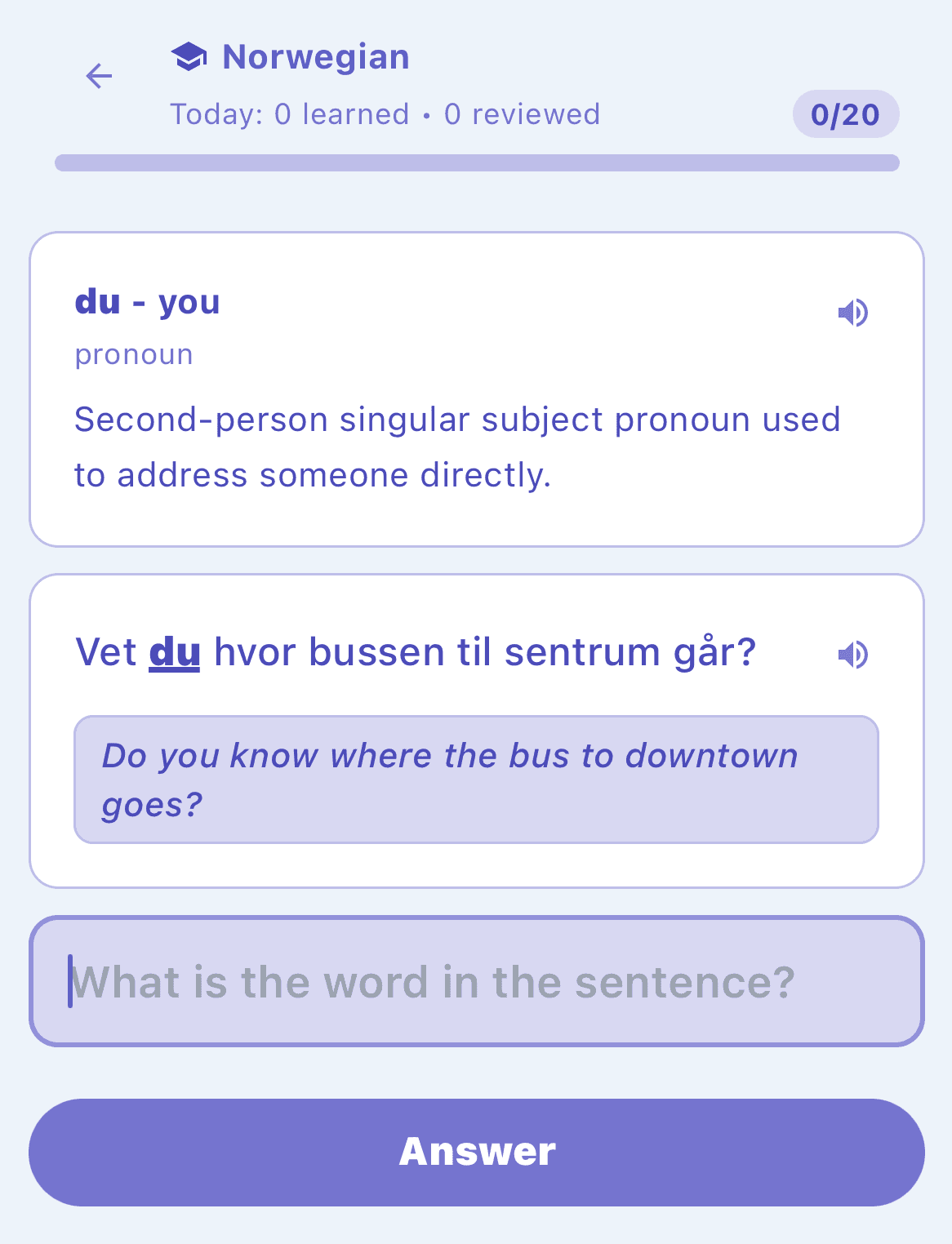
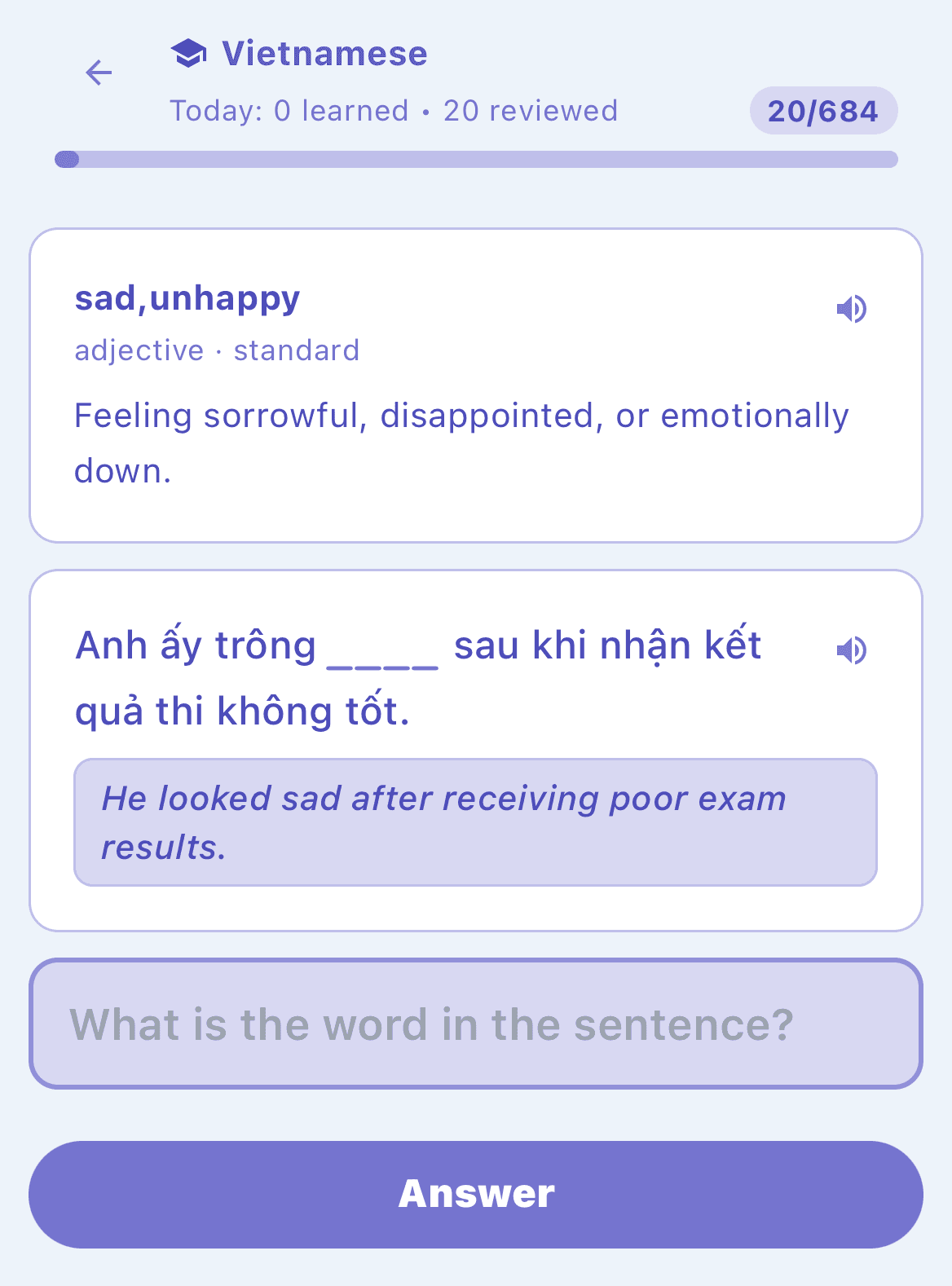
Recall from Context
During review, the target word is hidden. You recall it from the sentence context, training natural usage.
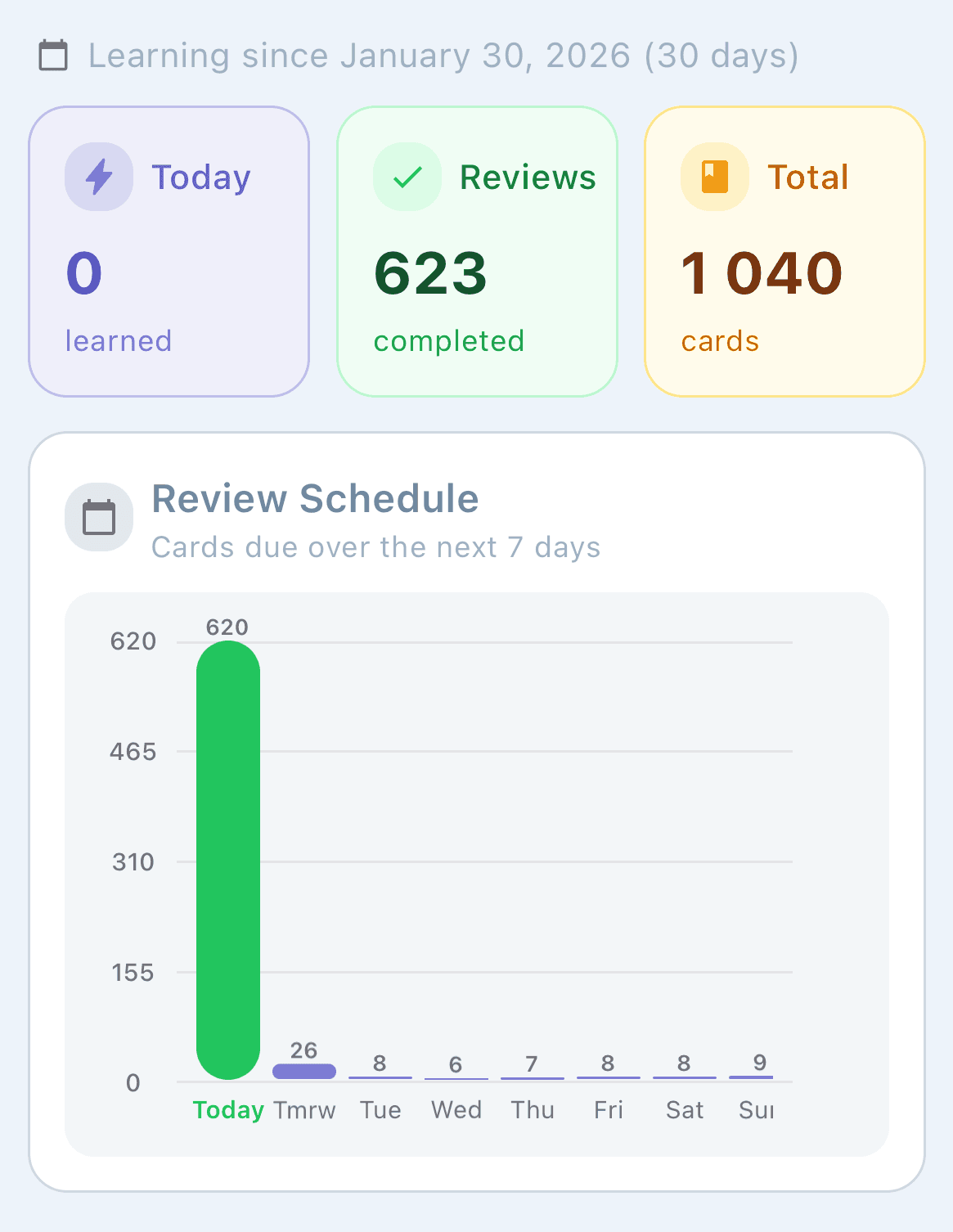
Smart Scheduling
FSRS calculates the optimal review time for each word. Difficult words appear more often, easy ones less frequently.
Six tones, one syllable
Say "ma" six ways and you get six different words. This is why hearing and recalling words in context matters more than memorizing spellings.
ma
ngang · levelNo mark. A flat, even tone. Meaning here: ghost.
má
sắc · risingAcute accent. A high, rising tone. Meaning here: cheek, or "mother" in Southern usage.
mà
huyền · fallingGrave accent. A lower, falling tone. Meaning here: but, which.
mả
hỏi · dippingHook above. A tone that dips and rises in the Hanoi standard. Meaning here: tomb.
mã
ngã · broken risingTilde. A rising tone with a catch in the Hanoi standard. Meaning here: horse (Sino-Vietnamese), code.
mạ
nặng · heavyDot below. A low, short, heavy tone. Meaning here: rice seedling.
Tone descriptions follow the Hanoi (Northern) standard. In much of the South, hỏi and ngã sound the same, but the spelling still tells them apart, so learning to read the marks pays off in every region.
Reading the marks
Vietnamese spelling packs a lot into the letters. Three things to know before your first word.
Two kinds of marks
Some marks change the vowel itself (ă, â, ê, ô, ơ, ư). Others show the tone (á, à, ả, ã, ạ). One letter can carry both, as in ế, ộ and ử, so a single vowel can say a lot.
đ is its own letter
The crossed d (đ) is a separate letter from plain d, so đi (to go) and di are different syllables. Cards show the full spelling with every mark, so you learn the real form rather than a stripped-down one.
Spaces separate syllables
Every syllable is written separately. A word can be one syllable (ăn, to eat) or several, like xin chào (hello) or cảm ơn (thank you). Learning words in a sentence shows you where one word ends and the next begins.
Words with marks you'll learn to read
What You Get
Each feature answers a reason learners stall, so you keep going until the words stick.
“I don't know which words to learn”
The words you'll actually hear
Courses of 10,000 words ordered by how often people use them, so every session pays off.
“Flashcards don't stick”
Recall from real sentences
The word is hidden in a real sentence, with native audio. You recall it the way you'll need it.
“I forget everything”
Reviews right before you forget
FSRS plans each review for the moment you would otherwise forget it.
“I don't know how it sounds”
Hear every word
Words and example sentences come with audio, so you learn how they sound as you learn what they mean.
“I don't get why it's said that way”
Notes and grammar on every card
Tap a card for word notes, sentence notes and the grammar behind it, where a course has them.
“I quit after a week”
Streaks, XP and freezes
Daily streaks, XP and levels. A streak freeze saves your streak on a missed day.
“Is this even working?”
See how much you understand
Your mastered words, plus an estimate of how much everyday text your words cover.
“I want it my way”
Study your way
Answer by self check, multiple choice, letter groups or writing. Choose reviews first, mixed or new words first.
What works differently from English
A few patterns that change how you build and remember Vietnamese sentences.
Verbs don't conjugate
A verb keeps the same form for every person and tense. Time is shown with small words such as đã (already), đang (in progress) and sẽ (will), so those words are worth learning early.
Pronouns carry relationship
Beyond tôi (I) and bạn (you), speakers often choose words like anh, chị or em depending on age and relationship. Seeing them in example sentences helps you pick up when each one fits.
Counting needs classifiers
Between a number and a noun, Vietnamese often adds a classifier word such as cái or con. Learning each noun inside a sentence means you meet its classifier together with it.
Built on What Research Shows
Vocabulary size sets the ceiling on understanding, and review timing decides what you keep. Here is the evidence behind the method.
80%+
of everyday speech
A small core carries most communication
A few thousand of the most frequent words account for the overwhelming majority of what people actually say and write. Learn that core first and you understand most of what you hear.
98%
of words known
Where comprehension stops needing help
Research on English finds unassisted listening takes about 6,000-7,000 word families and unassisted reading 8,000-9,000. 10,000 words is the milestone designed to clear both thresholds.
75%
forgotten in 6 days
Without review, memory fades fast
Ebbinghaus found people forget 56% after 1 hour and 75% after 6 days. MassVocabulary schedules each review for just before you would forget.
Read the research behind spaced repetition
Coverage research counts word families — a headword plus its inflections and derivations — so treat these as calibrated targets rather than exact counts.
Research & Citations
- Nation, I. S. P. (2006) — How Large a Vocabulary Is Needed for Reading and Listening?
- Hsueh-chao, M. H. & Nation, P. (2000) — Unknown Vocabulary Density and Reading Comprehension
- Kremmel, B. et al. (2023) — Unknown Vocabulary Density and Reading Comprehension: Replicating Hu and Nation (2000)
- Schmitt, N. (2008) — Instructed Second Language Vocabulary Learning
- Ebbinghaus, H. (1885) — Memory: A Contribution to Experimental Psychology
- Ye, J. (2024) — FSRS: A Modern Spaced Repetition Algorithm
- Pimsleur, P. (1967) — A Memory Schedule
Preview the Vietnamese words
Browse the most common Vietnamese words with translations and audio, free, before you start the course.
See the Vietnamese word listLanguages and platforms
Start learning today, with more languages on the way.
New to a language?
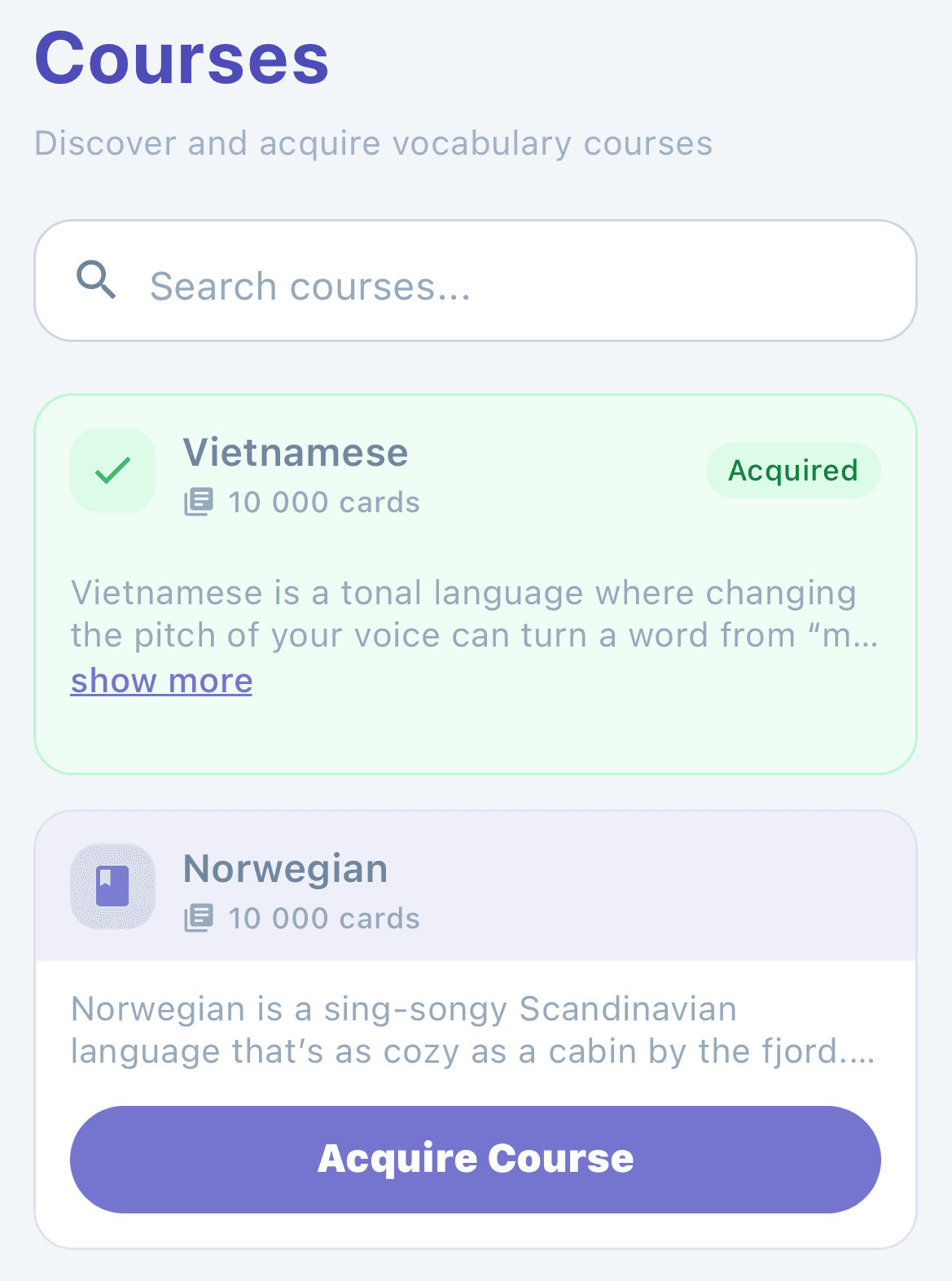
Start fresh with curated courses. Learn the most common words first with frequency-ordered vocabulary — the fastest path to real conversations.
Stuck at the intermediate plateau?
Focus on the vocabulary that's actually holding you back. Spaced repetition surfaces the words you keep forgetting and keeps them in front of you until they stick.
Runs in your browser. Sign in with Google, an email code or a password.
Web
Available
iOS
Coming soon
Android
Coming soon
Learning Vietnamese: Common Questions
What English speakers ask most before starting Vietnamese.
Do I need to learn the tones before the words?
No. Tones are part of each word, so you learn them together. Every Vietnamese card shows the full spelling with its tone mark and plays audio, and you recall the word from a sentence, which trains your ear and your reading of the marks at the same time.
How many tones does Vietnamese have, and do they matter?
The Hanoi (Northern) standard has six tones: ngang, huyền, sắc, hỏi, ngã and nặng. They matter because they distinguish words, as in ma, má, mà, mả, mã and mạ, which are six different words. In context, the surrounding sentence usually makes the meaning clear while your ear is still developing.
Northern or Southern Vietnamese: which should I learn?
The written words and tone marks are the same across regions, so the spelling you learn here works everywhere. Pronunciation and some vocabulary differ by region; for example, many Southern speakers pronounce hỏi and ngã the same way. Pick the accent of the people you plan to talk with and use the audio as a model, not the only one.
Do I need a Vietnamese keyboard to use MassVocabulary?
Not to get started. You can answer by self check or multiple choice, so no typing is required. If you want to practice writing, you can switch to the writing mode and type the word with your device's Vietnamese keyboard layout.
How does MassVocabulary teach Vietnamese?
Every word is presented inside a real example sentence with audio. During review the target word is hidden and you recall it from context, training natural usage instead of isolated translation. An FSRS spaced-repetition engine then reschedules each word for the moment just before you'd forget it.
Why learn Vietnamese words in frequency order?
Frequent words show up in almost every conversation and text, so each one you learn pays off sooner. Because many Vietnamese words are built from short syllables that recombine, the common ones also become the building blocks for words you meet later.
Can I see the words before I sign up?
Yes. The free Vietnamese word list at /words/vi-en shows the 100 most common Vietnamese words with English translations and audio, so you can check the style before you start.
Learn the tones by hearing them
Every Vietnamese word comes in a real example sentence with audio, so you learn the tones by ear as well as by sight. Free to use.
Your reviews are never locked.
Free right now: no daily limit on new words, and unlimited reviews.
Not ready? Try the account-free demo above ↑